Last updated 2026-08-17
TL;DR
Alaska requires secondhand dealers who buy catalytic converters to register with the state and keep written purchase records including seller ID and vehicle VIN. There is no dedicated "cat converter" license; you work under the Secondhand Dealer Act. Budget roughly $200, $600 for state registration, $100, $300 for a city business license, and 2 to 6 weeks for approvals. Confirm current fees with the Alaska Division of Corporations.
What is a cat converter desk and why Alaska has specific rules for it
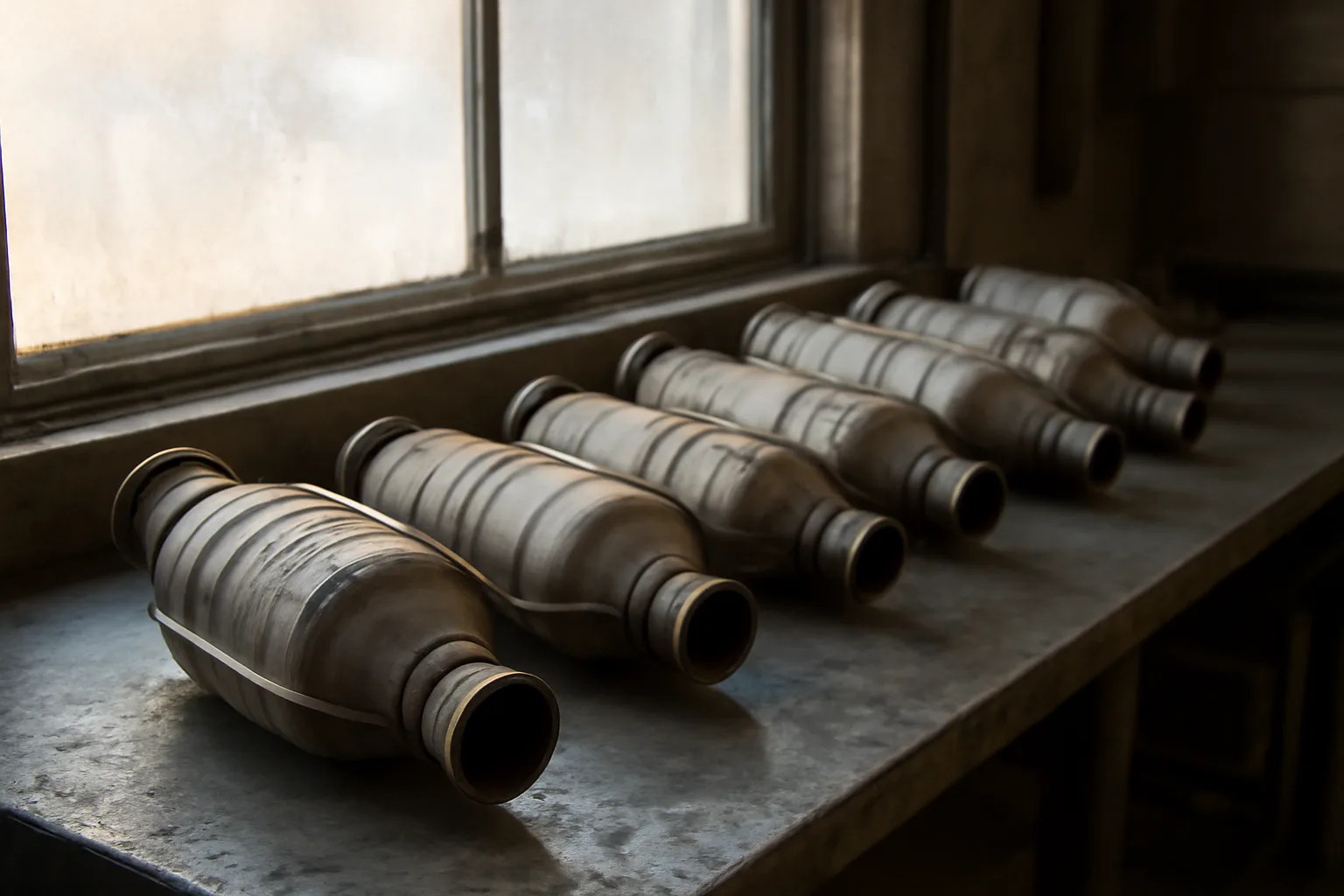
A cat converter desk is a buying operation, typically run from a fixed location or as a mobile window at a salvage yard or auto shop, that purchases used catalytic converters from the public and sells them to core processors or refiners. The desk handles paperwork, pays sellers, and ships cores. That's it.
Alaska cares about cat converter desks for one reason: catalytic converters are one of the most stolen vehicle parts in the country. The National Insurance Crime Bureau reported that U.S. catalytic converter theft claims rose from roughly 3,389 in 2019 to 64,701 in 2022, a nearly 1,900% jump over three years [1]. Alaska is not exempt, and the legislature responded by tightening the secondhand dealer record-keeping rules that govern who can buy and resell converters.
Run even a part-time cat converter desk in Alaska and you are a secondhand dealer under state law. Full stop. The exemption for occasional private sales does not reach a business that regularly acquires converters for resale.
Do you need a license for a cat converter desk in Alaska?
Yes. Alaska's Secondhand Dealer Act, codified at AS 08.76, requires anyone who regularly buys personal property (including automotive parts) for resale to register with the state and keep records [2]. The definition of "secondhand dealer" is broad enough to cover a standalone cat converter buying desk.
Beyond state registration, nearly every Alaska municipality adds its own business license. Anchorage, Fairbanks, and Juneau each run local licensing frameworks, and operating without the local license draws fines that stack on top of the state penalty.
Here is the layered license picture for most Alaska cat converter desks:
| Requirement | Issuing body | Where to apply |
|---|---|---|
| State business license | Alaska DCCED, Division of Corporations | corporations.alaska.gov |
| Secondhand dealer registration | Alaska DCCED | corporations.alaska.gov |
| City/municipal business license | Local municipality | City clerk or finance dept |
| Seller ID log compliance | Alaska DPS / local PD | Operational requirement, no separate license |
Some operators also need a scrap metal dealer permit if they are buying converters already removed from vehicles and sold as raw scrap rather than functional cores. Check with the Alaska Division of Corporations and your local police department before you assume your operation falls cleanly into one category.
AS 08.76 carves out no exemption for low-volume buyers. A desk doing five transactions a week is subject to registration [2].
What record-keeping does Alaska law require for each purchase?
This is the operational core of running a legal desk. Alaska's secondhand dealer rules, plus the converter-specific requirements added by HB 79 (enacted 2022), require dealers to record specific information for every converter they buy [3].
For each transaction you must record:
- The date and time of purchase
- A description of the catalytic converter (manufacturer markings if visible, converter type)
- The vehicle identification number (VIN) of the vehicle the converter came from
- The seller's full name, address, and government-issued photo ID number
- The license plate number of the vehicle the seller arrived in, if different from the source vehicle
- The purchase price paid
The VIN requirement is the hard one. A seller who cannot or will not give a VIN is a red flag, and your records have to show you asked. HB 79 targeted the "loose converter" problem, where stolen converters moved without any vehicle provenance [3].
Records must be kept at least three years and made available for inspection by law enforcement without a warrant, consistent with the administrative search doctrine that applies to regulated industries. The Alaska Department of Public Safety has authority to inspect secondhand dealer records [6].
Pay-out timing matters too. Alaska law imposes a holding period before you can resell or melt acquired converters, giving law enforcement a window to flag stolen property. Confirm the current holding period with the Division of Corporations, since the legislature has amended this provision since 2022.
For operators who want a structured system for VIN logs and purchase records, CatConPath's $179 VIN-Log + Theft-Compliance Kit at /start is built around exactly these Alaska-style documentation fields, though the law is what actually governs you.
How much does a cat converter desk cost to start in Alaska?
Costs fall into two buckets: government fees and operational setup. The government fees are fixed. The operational costs swing wide depending on if you're adding a desk to an existing shop or starting from zero.
Government and registration fees
Alaska's base business license is $50 for a two-year term for most small businesses, issued by the Division of Corporations, Business, and Professional Licensing [4]. The secondhand dealer registration carries a separate fee; confirm the current amount at the Division of Corporations because it has changed since 2022.
Municipal licenses vary. Anchorage's general business license fee has historically run $75, $100 per year [5]. Fairbanks and Juneau set their own schedules. Budget $100, $300 for local licensing depending on your city.
Operational setup costs
| Item | Estimated cost range | Notes |
|---|---|---|
| State business license | $50 / 2 years [4] | Confirm current fee |
| Secondhand dealer registration | $100, $300 | Confirm with DCCED |
| Municipal business license | $75, $200/year [5] | Varies by city |
| Record-keeping software or log kit | $0, $250 | Paper logs are legally acceptable |
| Scale (for core weight) | $150, $600 | Optional but standard |
| Liability insurance (annual) | $800, $2,500 | General commercial policy |
| Safe or locking storage | $200, $1,000 | Strongly recommended |
| Signage and posted notices | $50, $150 | State law requires posted buyer info |
Total first-year government and compliance costs: roughly $325, $750 in fees alone, before insurance or equipment. Total startup for a lean desk: $1,500, $5,000. A more built-out operation with secure storage and full insurance can run $8,000, $15,000 in year one.
Nobody has solid Alaska-specific data on average desk startup costs. Those ranges come from applying Alaska's published fee schedules and comparable secondhand dealer cost data from other northern states. Treat them as planning anchors, not guarantees.
How long does it take to get licensed for a cat converter desk in Alaska?
Processing times at Alaska DCCED have ranged from 10 to 30 business days for business license applications filed online, though the Division does not publish a guaranteed turnaround [4]. Secondhand dealer registration adds a parallel review that can run concurrently or add days depending on staffing.
Municipal licenses sometimes issue same-day (for over-the-counter applications in smaller cities) or take 2 to 4 weeks in larger municipalities like Anchorage that route applications through a review queue.
Realistic total timeline for a new desk: 3 to 6 weeks if everything is filed correctly the first time. Errors or missing documents reset the clock. A second submission cycle adds another 2 to 4 weeks.
The only way to move faster is to submit complete applications with every supporting document on the first pass. Miss a single required attachment (proof of business address, ID, bond if required) and your application pauses.
Do not start buying converters before your registrations clear. Operating as an unregistered secondhand dealer in Alaska is a class B misdemeanor under AS 08.76 [2].
How does Alaska's secondhand dealer registration process actually work?
Here is the actual sequence:
1. Register your business entity (LLC, sole proprietor, corporation) with the Alaska Division of Corporations at corporations.alaska.gov. This step gives you an Alaska Business Name and entity ID.
2. Obtain your Alaska Business License from the same division. The application is online and asks for your entity information, business address, and principal business activity code.
3. Apply for secondhand dealer registration. This is a separate application and may require a bond or surety instrument; confirm the current bonding requirement with DCCED.
4. Apply for your municipal business license with your city or borough. Anchorage uses an online portal; smaller municipalities may want an in-person visit to the clerk's office.
5. File your compliance plan with local law enforcement. Some Alaska police departments ask new secondhand dealers to introduce themselves and confirm their record-keeping process before opening. It's not always a formal requirement, but it's a relationship worth having.
6. Set up your purchase log system before your first transaction. The law requires records from day one, not after a grace period.
Step 3 trips up most first-time operators because they assume the business license covers the dealer registration. It does not. They are separate instruments.
What are Alaska's payment rules for converter purchases?
Alaska's HB 79 restricts cash payments for catalytic converters above a threshold amount, though you need to confirm the specific dollar limit against current statute text because the legislature has been active here [3]. The direction of the law mirrors what about a dozen states have adopted: payments over a set amount must go by check or electronic transfer, creating a paper trail cash cannot provide.
The practical effect is that your desk needs a bank account and the ability to issue checks or ACH payments. Some desks use prepaid debit card systems, but those arrangements have to be checked against the current payment method requirements in the statute, since not all electronic instruments qualify.
Paying cash above the threshold is a civil violation that can pull your dealer registration. It's not worth it.
Does Alaska have a waiting period before you can resell purchased converters?
Yes. Alaska's secondhand dealer framework includes a holding period, usually measured in business days, during which purchased items must be held and available for law enforcement inspection before they can be resold, transferred to a processor, or altered [2]. The specific number of days is subject to legislative amendment; confirm the current holding period with DCCED or against AS 08.76 directly.
That holding period changes how you run the desk. You cannot take a load on Monday and ship it to your refiner by Wednesday unless the holding period has run out. You need storage, either on-site or at a licensed facility, that is secure and accessible to law enforcement during business hours.
Small desks routinely underestimate how much space a proper holding inventory eats. A week of converters at even modest volume takes real floor space. Plan your layout around the holding requirement before you sign a lease.
What insurance does a cat converter desk in Alaska need?
Alaska does not mandate a specific insurance product for secondhand dealers beyond any bonding requirement in the registration process. Running without insurance is still a bad plan.
At minimum, a cat converter desk needs general commercial liability insurance. Limits of $1,000,000 per occurrence are standard for small dealer operations. If you store significant converter inventory (which carries real metal value), you also need inland marine or commercial property coverage that specifically covers catalytic converters, because standard property policies sometimes exclude auto parts inventory.
Theft of your own inventory is the biggest single risk. A pallet of converter cores can be worth $5,000, $30,000 depending on mix and market prices. If that pallet walks out the door, an uninsured desk eats the full loss.
Get quotes from insurers who write commercial auto salvage or scrap dealer policies specifically. General business insurers sometimes exclude "precious metal" content, and converters contain platinum, palladium, and rhodium, which can trip that exclusion.
For how other states handle similar regulatory ground, the cat converter desk license in California guide covers one of the more insurance-conscious states.
How does Alaska compare to neighboring states for cat converter desk regulations?
Alaska's framework is moderately strict against the lower-48 average. The VIN documentation requirement and payment restrictions put it in roughly the same tier as Colorado and Arizona, both of which passed similar legislation between 2021 and 2023.
| State | Secondhand dealer license required | VIN documentation required | Cash payment restriction | Holding period |
|---|---|---|---|---|
| Alaska | Yes (AS 08.76) [2] | Yes (HB 79) [3] | Yes (confirm threshold) | Yes (confirm days) |
| Arizona | Yes | Yes | Yes ($10 threshold) | Yes (3 days) |
| Colorado | Yes | Yes | Yes ($50 threshold) | Yes (3 days) |
| California | Yes | Yes | Yes ($0, check only) | Yes (3 days) |
| Alabama | Yes | Partial | No statewide rule | Varies |
Sources: state statute reviews; Arizona and California thresholds from state published guidance. Alaska thresholds: confirm with current AS 08.76 text [2][3].
Alaska's remoteness creates a wrinkle no lower-48 state faces: shipping cores to refiners costs far more per pound because of freight from Anchorage or Fairbanks to the continental U.S. That hits your margin even when the regulatory burden matches Arizona.
For a broader picture, the how to start a cat converter desk in Arizona guide and cat converter desk license in Colorado guide are worth reading alongside this one.
What does the actual day-to-day operation look like in year one?
Most Alaska desks open with one buyer, a scale, a camera, and a paper or software log. The first 90 days are mostly about building supplier relationships with auto shops, body shops, and salvage yards rather than walk-in public sellers.
Volume in Alaska is lower than in a dense lower-48 metro. A desk in Anchorage might process 50 to 150 converters per month to start; a desk in Fairbanks will likely see less. That's not a business-ender, but it means your profitability rides on buying price discipline and freight cost management.
The record-keeping burden is real. Every transaction generates a log entry, a copy of the seller's ID, and a VIN record. Doing this by hand in a notebook, budget 5 to 10 minutes per transaction for documentation. At 10 transactions a day, that's close to an hour of paperwork. Many desks move to a structured log kit or software after the first few months.
CatConPath's $179 VIN-Log + Theft-Compliance Kit at /start is one option for structuring that paperwork from day one, built around the record fields that Alaska and similar state laws require.
For neighboring-state context on operational patterns, the how to start a cat converter desk in Alabama guide covers a different regulatory environment but similar first-year operational challenges.
Expect your first state or local inspection sometime in year one. Alaska law enforcement does run spot-check audits of secondhand dealer records. Clean, complete logs make an inspection a non-event. Missing entries or seller IDs, and you're looking at a warning or worse.
Where to file and who to call for Alaska cat converter desk registration
Alaska Division of Corporations, Business, and Professional Licensing is your primary contact. Their online portal handles both business license applications and, for most professional registrations, the underlying dealer registration.
DCCED mailing address: Division of Corporations, Business, and Professional Licensing, P.O. Box 110806, Juneau, AK 99811-0806.
Phone: (907) 465-2550 (confirm current number at the DCCED website).
Online application portal: corporations.alaska.gov [4].
For questions about record-keeping specifics and law enforcement reporting, contact your local Alaska State Troopers post or, in Anchorage, the Anchorage Police Department property crimes unit.
For municipal licenses in Anchorage, the starting point is the Anchorage Finance Department, business licensing section [5].
Do not rely on what a previous owner or another dealer tells you the requirements are. AS 08.76 has been amended multiple times since 2019, and informal guidance from other operators is frequently outdated.
Frequently asked questions
Do you need a license for a cat converter desk in Alaska?
Yes. Alaska requires secondhand dealer registration under AS 08.76 for any business that regularly buys personal property, including catalytic converters, for resale. You also need a state business license and a municipal business license from your city or borough. Operating without registration is a class B misdemeanor. Confirm current registration requirements with the Alaska Division of Corporations, Business, and Professional Licensing.
How much does it cost to start a cat converter desk in Alaska?
Government fees alone run roughly $325, $750 for the first year, covering the state business license ($50 for two years), secondhand dealer registration (confirm current fee with DCCED), and a municipal license ($75, $200). Add insurance ($800, $2,500), storage, and basic equipment and a lean first-year budget is $1,500, $5,000. Confirm all current fee amounts with the relevant agencies before filing.
How long does cat converter desk licensing take in Alaska?
State business license processing at Alaska DCCED typically runs 10 to 30 business days for online applications. Secondhand dealer registration runs concurrently but may add time. Municipal licenses add another 1 to 4 weeks depending on the city. Total realistic timeline is 3 to 6 weeks from first filing to all approvals, assuming clean first submissions. Errors or missing documents reset the clock.
What records does Alaska require for each catalytic converter purchase?
Alaska's HB 79 (2022) and the secondhand dealer rules require: date and time of purchase, converter description and visible markings, the VIN of the vehicle the converter came from, the seller's full name and photo ID number, the seller's vehicle license plate, and the purchase price. Records must be kept at least three years and made available for law enforcement inspection.
Can you pay cash for catalytic converters in Alaska?
Alaska restricts cash payments for converter purchases above a statutory threshold, requiring check or electronic payment instead. The specific dollar limit is in AS 08.76 as amended by HB 79; confirm the current threshold with the Division of Corporations or by reading the current statute text, because the legislature has amended this provision since 2022.
Does Alaska require a holding period before reselling purchased converters?
Yes. Alaska's secondhand dealer framework includes a holding period during which purchased converters must be retained and available for law enforcement inspection before resale or transfer to a processor. The specific number of business days is subject to amendment; confirm the current requirement with DCCED or the current text of AS 08.76 before you plan your shipping schedule.
Do you need a VIN for every catalytic converter you buy in Alaska?
Yes. HB 79, enacted in 2022, specifically requires buyers to document the vehicle identification number of the vehicle from which a catalytic converter was removed. A seller who cannot or will not provide a VIN is a red flag, and your log must show you requested it. Buying converters without VIN documentation puts your dealer registration at risk.
Is a cat converter desk legal in rural Alaska or only in cities?
The state registration requirement under AS 08.76 applies statewide, including rural areas. Municipal license requirements only apply within incorporated cities or boroughs. In unincorporated areas you still need the state business license and secondhand dealer registration. Contact DCCED to confirm whether your specific location triggers additional requirements, particularly if you are in a borough with its own ordinances.
What insurance does an Alaska cat converter desk actually need?
At minimum, commercial general liability at $1,000,000 per occurrence. Because catalytic converters contain platinum, palladium, and rhodium, standard property policies sometimes exclude precious metal content, so verify that your commercial property or inland marine policy explicitly covers converter inventory. Theft of stored inventory is the largest single operational risk for a converter desk.
How does Alaska's cat converter regulation compare to other states?
Alaska sits in the moderately strict tier alongside Arizona, Colorado, and California. All four require secondhand dealer registration, VIN documentation, payment restrictions, and holding periods. Alaska's main operational difference from lower-48 states is freight cost to ship cores to processors on the mainland, which compresses margins even when the regulatory burden is comparable to states like Arizona or Colorado.
Can an existing auto shop or salvage yard add a cat converter desk without a new license?
Possibly, but not automatically. If your existing business license does not include secondhand dealer activity, you likely need to add that registration with DCCED. Some municipalities also require an amended or additional local license for the new activity type. Do not assume your current business license covers converter buying without confirming with both the state and your local licensing authority.
What happens if you operate a cat converter desk without registration in Alaska?
Operating as an unregistered secondhand dealer in Alaska is a class B misdemeanor under AS 08.76. Beyond criminal exposure, you risk civil penalties, loss of eligibility to obtain a future dealer registration, and civil liability if a stolen converter transacted through your unregistered desk is traced back. Law enforcement does conduct spot-check inspections of secondhand dealers.
Where do I find the Alaska secondhand dealer application?
The Alaska Division of Corporations, Business, and Professional Licensing handles both the state business license and the secondhand dealer registration. Applications are available at corporations.alaska.gov. The DCCED phone line is (907) 465-2550; confirm this number at the DCCED website because agency contact information changes. Do not file based on informal guidance from other dealers, as AS 08.76 has been amended multiple times since 2019.
Does Alaska require a surety bond for a cat converter desk?
Alaska's secondhand dealer registration may require a surety bond or financial instrument; the requirement and amount are set by regulation under AS 08.76 and are subject to change. Confirm the current bonding requirement with DCCED before you submit your application, because a missing bond document will pause processing and add weeks to your timeline.
Sources
- National Insurance Crime Bureau, catalytic converter theft data: U.S. catalytic converter theft claims rose from 3,389 in 2019 to 64,701 in 2022, a nearly 1,900% increase
- Alaska Statutes, AS 08.76 Secondhand Dealers, Alaska Legislature: Alaska requires secondhand dealer registration under AS 08.76 for businesses that regularly buy personal property for resale; operating without registration is a class B misdemeanor
- Alaska HB 79, 32nd Legislature (2022), Alaska Legislature: HB 79 (2022) added VIN documentation requirements and payment restrictions for catalytic converter purchases in Alaska
- Alaska Division of Corporations, Business, and Professional Licensing, Business License Program: Alaska business license costs $50 for a two-year term and applications are filed online through DCCED
- Alaska Department of Public Safety: The Alaska Department of Public Safety has authority to inspect secondhand dealer purchase records under AS 08.76
- Arizona Revised Statutes, Title 44 Chapter 11 (Secondhand Dealers and Pawnbrokers), Arizona State Legislature: Arizona's secondhand dealer law includes a cash payment threshold and holding period for catalytic converters
- Colorado Revised Statutes, Title 18, Colorado General Assembly: Colorado's catalytic converter purchase law imposes a cash payment threshold and holding period
- California Business and Professions Code, Section 21608.5, Catalytic Converter Sales: California prohibits all cash payments for catalytic converter purchases, requiring check or electronic payment for any amount